Cracked Nipples Breastfeeding: How to Heal Fast (Pigeon Singapore)
Cracked or bleeding nipples during breastfeeding are common, usually fixable at home, and most parents see healing within 7 to 10 days once the latch is corrected. The two quickest wins: fix the latch, and protect the skin between feeds with breast milk, lanolin, or a cream like Pigeon Nipple Care Cream. See a lactation consultant or your pediatrician right away if you spot early mastitis signs, deep fissures, or pus.

This article is for informational purposes only and is not a substitute for professional medical advice. If your nipples are bleeding heavily, you have fever, or baby is losing weight, contact your pediatrician, KK Women's and Children's Hospital lactation clinic, or the Breastfeeding Mothers' Support Group Singapore helpline.
Nipple pain catches new parents off guard. Breastfeeding is supposed to be natural, yet the first two weeks are often the most painful stretch of the entire journey. If you are reading this with a wincing latch on one side and cracked skin on the other, you are not doing anything wrong. Most Singapore parents hit this wall. Most also heal from it within days once they know which tiny adjustments actually matter.
Pigeon has spent more than 70 years researching how mothers and babies feed together, from our R&D facility in Japan to the lactation support work we do here in Singapore. This guide covers what the pain usually means, what heals it fastest, which products help (including honest comparisons), and the warning signs that need a doctor, not a cream.
Is Your Nipple Pain Normal or a Red Flag? (Quick Diagnostic)

| Symptom | Likely cause | First action |
|---|---|---|
| Tenderness in first 2 weeks, fades as feed progresses | Early-days adjustment | Expected, check latch |
| Pain that stays or gets worse through the feed | Shallow latch | Unlatch, reposition |
| Visible cracks or scabs on the nipple | Latch + friction damage | Treat skin, fix latch |
| Bright red bleeding, small amount | Cracked skin | Usually safe to continue |
| Pink tinge in baby's spit-up | Small amount of swallowed blood | Not urgent, still address source |
| Stabbing, shooting pain between feeds | Possible vasospasm or early thrush | See lactation consultant |
| Fever + red warm patch on breast | Possible mastitis | See doctor same day |
| Pus, foul smell, spreading redness | Infection | See doctor urgently |
The first four rows are the everyday reality of early breastfeeding. The last three are the red flags. If you are in the bottom half of the table, skip ahead to our "When to See a Doctor" section.
The First 48 Hours: What to Do Right Now

Most healing starts the moment you stop the cause, which is almost always the latch. Skin repairs quickly once the friction is off.
1. Fix the latch in the next feed
Signs of a shallow latch: baby has only the nipple in their mouth, you hear clicking, your nipple comes out flattened or creased on one side. A deeper latch looks like this: baby's chin is pressing into your breast, their lower lip is flared outward, more of the lower areola is in their mouth than the upper. If you are not sure, a Singapore-trained IBCLC (International Board Certified Lactation Consultant) can correct it in one visit. KK Women's and Children's Hospital runs a lactation clinic, and the Breastfeeding Mothers' Support Group Singapore has peer-support calls.
2. Protect the skin between feeds
Three options, any of which work:
- Your own breast milk. Hand-express a drop, rub it gently into the nipple and areola, let it air dry. Breast milk has antibacterial properties and does not need to be wiped off before the next feed.
- Pure lanolin cream. Safe for baby, does not need wiping off. Lansinoh and Medela Purelan are both 100% lanolin. Pigeon's Nipple Care Cream is also safe for baby to ingest and is formulated to be lighter and less sticky for Singapore's humid climate.
- Hydrogel pads. Kept in the fridge for extra comfort, placed over the nipple between feeds. They speed healing of open cracks.
3. Let the skin breathe
Avoid tight bras or pads that press wet fabric against cracked skin. Between feeds, a few minutes of air helps. Breast pads should be changed the moment they feel damp, not just when visibly saturated. More on this in the Breast Pads section below.
Cracked Nipples: Causes, Healing, and What Works
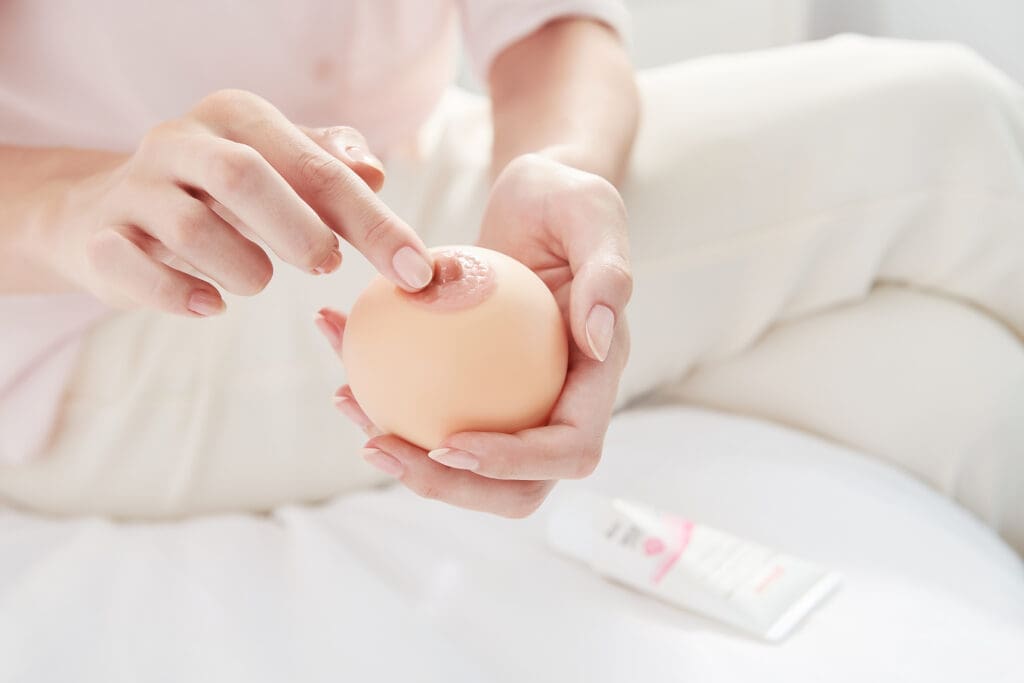

What causes cracked nipples
In order of how often we see them in the first six weeks:
- Shallow latch (by far the most common)
- Baby pulling off mid-feed without unlatching properly
- Strong suction from a very hungry baby
- Nipple rubbing against bra or pad fabric
- Thrush infection (if pain persists with good latch)
- Tongue tie in baby, affecting their suck mechanics
Healing timeline: what normal looks like
With the latch corrected and skin protected, you should see the edges of a crack starting to close within 48 hours. Full healing of a visible fissure takes about 5 to 10 days. If a crack is deeper than skin surface, or if it is not improving by day 7, that is when we recommend seeing a lactation consultant rather than waiting it out.
Pigeon Nipple Care Cream vs Lansinoh vs Medela Purelan
Parents often ask which cream to pick. Honest comparison, because all three work, and the right choice depends on how your skin reacts:
| Product | Base | Safe to ingest | Texture | Best for |
|---|---|---|---|---|
| Pigeon Nipple Care Cream 20g | Plant-based with lanolin blend | Yes, no wiping needed | Light, non-greasy | Humid climates, parents who dislike thick textures |
| Lansinoh HPA Lanolin | 100% ultra-pure lanolin | Yes | Thick, sticky | Deep cracks, overnight use |
| Medela Purelan | 100% lanolin | Yes | Medium | Middle ground between the two |
If you are already using Lansinoh and it works, there is no reason to switch. If you find lanolin too heavy in Singapore's humidity (a common complaint), Pigeon Nipple Care Cream 20g was formulated for exactly this climate and is widely available at Mothercare, Watsons, and Guardian.
Can I use vaseline or coconut oil instead?
Vaseline is petroleum-based and is not recommended on nipples during breastfeeding. It is safe in tiny amounts but will need to be wiped off thoroughly before each feed, which defeats the purpose of a protective layer. Coconut oil is gentler and has mild antimicrobial properties, but it can worsen thrush if that is the underlying issue. If you already have something at home that is working, great. If you are buying something new, a nipple-specific cream is the better starting point.
Bleeding Nipples: When It's Safe to Keep Feeding

A small amount of bright red blood on a cracked nipple is almost never dangerous for baby. Breast milk with blood in it might show up as a pink tinge in baby's spit-up, which looks alarming but passes quickly. Baby's digestive system handles it without issue.
It is usually safe to continue feeding when: - The bleeding is a few drops, not a flow - You are treating the underlying crack - Baby is gaining weight and producing wet nappies
Pause feeding on that side (pump and discard, or feed only the other side) if: - The wound is deep or actively bleeding heavily - Pus or foul smell is present - You have a fever above 38°C
See a doctor or lactation consultant if: - Bleeding does not slow after 48 hours of treatment - You see signs of mastitis (red warm patch, fever, flu-like feeling) - Pain suddenly worsens rather than easing
Nipple Shields: The Truth About When They Help


Nipple shields are one of the most searched and most debated tools in breastfeeding. Midwives are often cautious for good reasons, and they are also genuinely helpful in specific situations. Both things are true.
Why some midwives discourage shields
Used wrong, a shield can reduce milk transfer, which over time affects supply. Some babies also prefer the shield over the bare nipple once they get used to it, making weaning off the shield harder. Fair concerns. The fix is correct use and a clear weaning plan, not avoidance.
When a shield actually helps
- Flat or inverted nipples that baby cannot latch onto directly
- Severely damaged nipples where baby's latch is causing more harm while healing
- Premature babies with weak suck strength
- Babies with a tongue tie (as a short-term bridge while awaiting evaluation)
How to use a Pigeon Natural Feel Nipple Shield correctly

- Wet the inside of the shield with a little breast milk for suction.
- Flip the rim back over the shield before placing (this pulls your nipple into the shield and boosts transfer).
- Check baby is drinking by watching for swallowing motions, not just suckling.
- Weigh baby weekly while using the shield to monitor transfer.
- Aim to wean off within 4 to 8 weeks by trying a bare latch every few feeds.
The Pigeon Natural Feel Nipple Shield is designed with a rounded shape that mimics natural nipple contour, which can ease the weaning transition back to bare breast compared to flatter shield designs.
Do shields ruin milk supply?
Not by themselves. What affects supply is inadequate milk transfer, which can happen with any feeding method if baby isn't drawing milk well. If you are using a shield correctly, monitoring baby's weight, and pumping after feeds in early days if transfer is low, shields do not harm supply.
Breast Pads: Daily Comfort Without the Downsides

Leaking is normal in the first 6 to 12 weeks, especially around letdown. Breast pads catch the spillover so your bra and clothes stay dry.
Disposable vs reusable
Disposables are thinner and more absorbent per millimetre. Reusables are softer, kinder to sensitive skin, and more sustainable. Many parents use disposables during the day and reusable at night. Pigeon's ComfyFeel range includes both.
The "3 bra rule"
A useful habit for the leaking phase: three bras in rotation. One on your body, one drying after a wash, one clean and ready. This keeps pads changed out without laundry stress and reduces the risk of wet fabric sitting against sore nipples.
Can I use breast pads without a bra?
At home, yes. Pads can stick to the inside of a loose camisole or breathable top. They are designed to adhere to fabric, not skin, so they do not stay put directly on bare skin for long. A bralette or camisole keeps them in place.
The downsides to watch for
Wet pads pressed against cracked skin slow healing. Change pads the moment they feel damp, even if not visibly saturated. Synthetic materials can trap moisture more than cotton or bamboo options, which is worth considering in Singapore's humidity. The Pigeon ComfyFeel Breast Pads are designed with a breathable outer layer specifically for humid climates.
Other Nipple Problems You Might Face
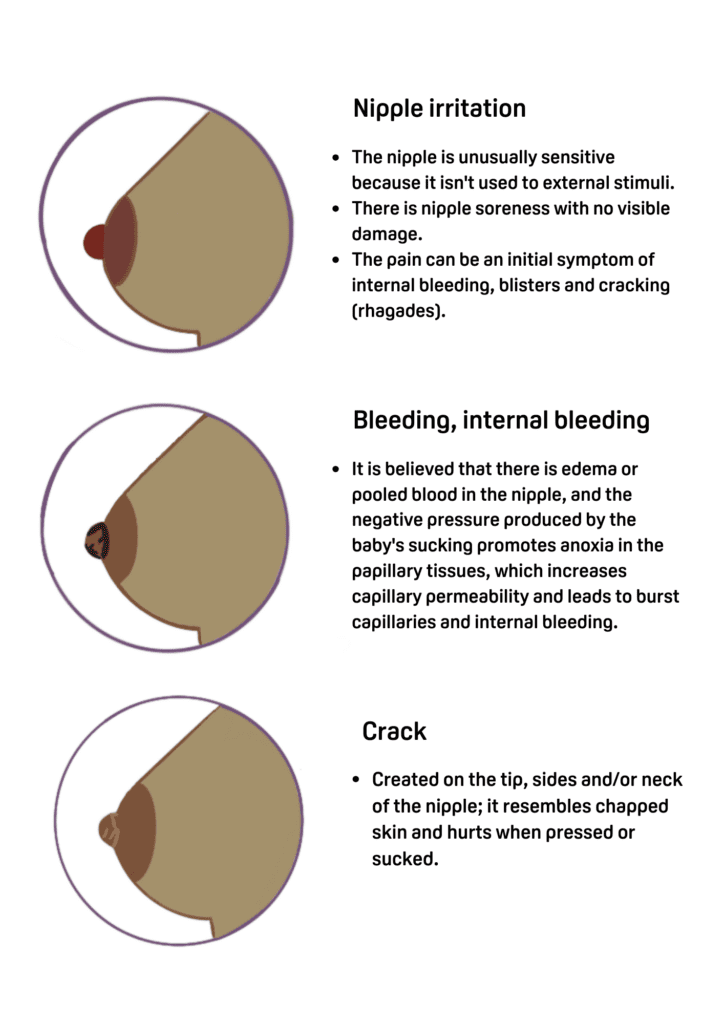
Thrush on the nipples
A yeast infection that presents as persistent sharp pain during and after feeds, sometimes with shiny pink skin. Baby may have white patches in their mouth. Thrush needs antifungal treatment for both mother and baby, prescribed by a doctor. Do not use over-the-counter antifungals without consulting your pediatrician, because some are not safe during breastfeeding.
Milk blebs (milk blisters)
A small white spot on the nipple, often painful, caused by a blocked milk pore. Sometimes clears with a warm compress before feeds and the baby's own suction. If it persists more than a few days or recurs, a lactation consultant can help open it safely. Do not attempt to pop it with a needle at home.
Nipple vasospasm (Raynaud's of the nipple)
Nipples turn white, then purple, then red after feeds, with sharp burning pain. More common in cold air-conditioned environments. Warming the breast immediately after feeds with a warm compress helps. Persistent cases may need medical evaluation.
Mastitis early warning signs

A red, warm, painful wedge-shaped patch on the breast, usually with fever and flu-like feeling, is mastitis until proven otherwise. Early signs are a blocked duct that does not clear with feeding or massage. If you develop a fever, contact your doctor same day. Mastitis is treatable with rest, continued feeding, and often antibiotics, but it progresses fast if ignored.
Singapore-Specific: Breastfeeding Through Confinement and Return to Work
Confinement period nipple care

Many Singapore families observe a confinement period in the first month. Confinement nannies often have strong views on breastfeeding, some helpful, some outdated. Two modern evidence points worth knowing: cold water on the body does not reduce milk supply, and herbal teas do not substitute for frequent feeding or effective pumping. The best thing for healing nipples in confinement is the same as anywhere else: good latch, skin protection, air circulation.
Pumping and return to work

Singapore's short maternity leave means many parents are back at work within 16 weeks while still breastfeeding. This transition can trigger new nipple issues: pump flange mismatch causing friction, missed feeds causing engorgement, tight work-clothes pressing against sore spots. Getting flange-fitted properly by a Singapore IBCLC before you return to work is the single most useful prep step. A poorly-fitted pump can cause cracks as quickly as a poor latch.
Combo feeding: preventing nipple confusion

If you are combining breast and bottle, the technique matters. A fast-flow bottle teat can teach baby to prefer bottles, making them fussy at the breast. Paced bottle feeding technique keeps the bottle experience closer to breastfeeding rhythm and prevents the preference issue that shows up as a baby fighting the bottle or refusing the breast.
Pigeon's Nipple Care Range: What Helps When

| Need | Product | Notes |
|---|---|---|
| Daily skin protection | Nipple Care Cream 20g | Plant-based blend, no wiping needed |
| Deep crack healing overnight | Nipple Care Cream + hydrogel pad | Cream underneath, pad over |
| Flat or inverted nipples | Natural Feel Nipple Shield (size M) | Round design eases weaning |
| Daily leak management | ComfyFeel Breast Pads (60pcs) | Breathable for humidity |
| Pumping without friction | Correctly-fitted breast pump flange | IBCLC fitting recommended |
Browse the full Pigeon breastfeeding accessories range or visit Mothercare, Watsons, Guardian, and Kiddy Palace across Singapore.
Frequently Asked Questions
Can I use vaseline as nipple cream?
Vaseline is petroleum-based and is not ideal on breastfeeding nipples. It is technically safe in tiny amounts but must be wiped off before each feed, which defeats the purpose. A nipple-specific cream like Pigeon Nipple Care Cream or pure lanolin is the better choice because it does not need wiping off.
When should I start applying nipple cream?
From the first feed if you are prone to dry or sensitive skin, or within the first 24 to 48 hours if nipples feel tender after feeds. Applying preventively is better than waiting for cracks to form.
Why not use lanolin on nipples?
Lanolin is generally safe and effective. The few reasons to avoid it: you have a wool allergy (lanolin comes from sheep), you prefer plant-based skincare, or you find the thick sticky texture uncomfortable in humidity. Pigeon's Nipple Care Cream is a plant-based alternative for these cases.
Should I still breastfeed if my nipples are sore?
Usually yes, because stopping short-term leads to engorgement and often worse cracks when you resume. The fix is almost always correcting the latch rather than pausing. If pain is severe enough that you dread feeds, pump that side instead for 24 hours while healing, and feed from the other side.
Why are nipple shields discouraged by some midwives?
Used incorrectly, shields can reduce milk transfer and over time lower supply. Used correctly for the right situations (flat nipples, severe cracks, preterm babies with weak suck), they are genuinely helpful. The problem is not shields as a tool, it is shields used without guidance or without a weaning plan.
Do nipple shields ruin milk supply?
Not by themselves. Supply drops when milk transfer drops. If baby is transferring milk well with a shield and you are monitoring weight gain, supply stays fine. Many Singapore parents use shields successfully for 4 to 8 weeks and wean off without issues.
Can I use breast pads without a bra?
At home, yes, especially if you wear a camisole or soft top that holds the pad in place. Pads are designed to stick to fabric, not bare skin, so a direct-on-skin approach does not stay put for long. Rotating 3 bras (one on, one washing, one clean) is the most practical system for the leak phase.
What is a red flag for breast pain?
Fever above 38°C combined with breast pain, red spreading patch on the breast, pus or foul smell from a crack, deep fissures that do not close after a week of treatment, or sudden severe pain between feeds without an obvious cause. Any of these is a same-day call to your pediatrician or lactation consultant.
What do early signs of mastitis feel like?
A blocked duct that does not clear with feeding, a lumpy tender area, a red warm wedge-shaped patch on the breast, body aches and fatigue, low-grade fever, and sometimes flu-like feeling. Mastitis progresses quickly, so early recognition matters. Keep feeding from the affected side, apply warm compresses, rest, and contact your doctor.
Is it okay to put cream on nipples between every feed?
Yes for creams designed to be safe for baby (Pigeon Nipple Care Cream, pure lanolin, Medela Purelan, Lansinoh). These do not need to be wiped off. Applying after each feed while skin is healing is standard practice.
Should I be worried if my nipple is bleeding?
Usually no. A small amount of blood on a cracked nipple is common and does not harm baby. A pink tinge in baby's spit-up is the swallowed blood passing through. Worry only if bleeding is heavy, if the wound smells or shows pus, if you develop a fever, or if bleeding does not improve within 48 to 72 hours of treating the crack.
What is the 3 bra rule?
A practical rotation for the leaking phase: one bra on your body, one drying after a wash, one clean and ready. It means you always have a dry clean option at hand when pads need changing. It keeps wet fabric off sore skin.
What are the disadvantages of breast pads?
They can press wet fabric against cracked skin if not changed promptly. Synthetic materials can trap moisture. Disposables create daily waste. Sensitive skin sometimes reacts to adhesives. Change pads as soon as they feel damp, choose breathable materials in humid weather, and rinse reusable pads after each use.
How do I know if my baby needs a nipple shield?
Common indicators: baby cannot latch onto a flat or inverted nipple, your nipples are so damaged that every latch is causing more harm while healing, baby is premature with a weak suck. An IBCLC can confirm whether a shield is the right tool or whether latch correction alone will resolve things.
Can nipple shields cause poor latch?
They can, if used long-term without a weaning plan. The fix is using the shield for a defined period (usually 4-8 weeks), attempting bare-breast latches every few feeds, and transitioning gradually as nipples heal or baby matures.
When should I see a lactation consultant in Singapore?
As soon as you know something is not right. KK Women's and Children's Hospital runs a lactation clinic. The Breastfeeding Mothers' Support Group Singapore has peer volunteers and a helpline. Private IBCLCs visit homes, which is especially useful in the first two weeks when leaving the house is hard.
What can I use instead of nipple cream?
Your own breast milk is the simplest, free option. Hand-express a drop, rub it in, let it air dry. It has antibacterial properties and does not need wiping off. For deeper cracks, a hydrogel pad adds cooling comfort. These work well alongside or instead of cream depending on your skin.
When to See a Doctor in Singapore
The same-day red flags are fever with breast pain, spreading redness, pus, severe sudden pain, or a wound that looks infected. Same-week flags are cracks that are not healing after 7 days of treatment, persistent sharp pain even with good latch, or any change that feels wrong.
Your options locally:
- KK Women's and Children's Hospital: lactation clinic, by referral or walk-in during hours. Public subsidy available.
- Your pediatrician or OB-GYN: for mastitis, thrush, or any concern that needs a prescription.
- Private IBCLC (International Board Certified Lactation Consultant): home visits, flexible hours.
- Breastfeeding Mothers' Support Group Singapore: peer helpline for non-urgent questions.
- Health Promotion Board (HPB): general health info and feeding guidance.
Most nipple problems heal at home with the right latch and skin care. The ones that need a doctor are a small but important minority. Knowing which is which is half the comfort of the first two weeks.
If you are combining breast and bottle feeding, our companion guide on paced bottle feeding technique covers how to bottle-feed in a way that protects the breastfeeding relationship.
You have got this. And Pigeon is here in Singapore if you need product help, questions, or just someone on the phone during a rough feed.
JSON-LD schema for this page
For dev / SEO reviewBlogPosting + FAQPage + BreadcrumbList. Entities (about + mentions) sourced from TextRazor + manually mapped Pigeon-specific entities to Wikidata/Wikipedia.
{
  "@context": "https://schema.org",
  "@graph": [
    {
      "@type": "BreadcrumbList",
      "@id": "https://pigeon.com.sg/tips_guides/nipple-problems/#breadcrumb",
      "itemListElement": [
        {
          "@type": "ListItem",
          "position": 1,
          "name": "Home",
          "item": "https://pigeon.com.sg/"
        },
        {
          "@type": "ListItem",
          "position": 2,
          "name": "Blogs & Articles",
          "item": "https://pigeon.com.sg/blogs_articles/"
        },
        {
          "@type": "ListItem",
          "position": 3,
          "name": "Cracked Nipples Breastfeeding: How to Heal Fast"
        }
      ]
    },
    {
      "@type": "BlogPosting",
      "@id": "https://pigeon.com.sg/tips_guides/nipple-problems/#blogposting",
      "headline": "Cracked Nipples Breastfeeding: How to Heal Fast",
      "description": "Cracked, bleeding or sore nipples while breastfeeding? Pigeon Singapore guide to fast healing, when to use shields, mastitis red flags, and Singapore confinement context.",
      "datePublished": "2023-08-10",
      "dateModified": "2026-04-21",
      "author": {
        "@id": "https://pigeon.com.sg/#organization"
      },
      "publisher": {
        "@id": "https://pigeon.com.sg/#organization"
      },
      "mainEntityOfPage": "https://pigeon.com.sg/tips_guides/nipple-problems/",
      "image": "https://b2907581.smushcdn.com/2907581/wp-content/uploads/2020/12/baby-eats-mother-s-breast-1-scaled.jpg",
      "inLanguage": "en-SG",
      "about": [
        {
          "@type": "Thing",
          "name": "Pigeon Singapore",
          "@id": "https://pigeon.com.sg/#organization"
        },
        {
          "@type": "Thing",
          "name": "Pigeon Corporation",
          "sameAs": [
            "https://www.wikidata.org/wiki/Q11331467",
            "https://en.wikipedia.org/wiki/Pigeon_Corporation"
          ]
        },
        {
          "@type": "Thing",
          "name": "KK Women's and Children's Hospital",
          "sameAs": [
            "https://www.wikidata.org/wiki/Q6328540",
            "https://en.wikipedia.org/wiki/KK_Women%27s_and_Children%27s_Hospital"
          ]
        },
        {
          "@type": "Thing",
          "name": "Cracked nipple",
          "sameAs": [
            "https://www.wikidata.org/wiki/Q2558350",
            "https://en.wikipedia.org/wiki/Cracked_nipple"
          ]
        },
        {
          "@type": "Thing",
          "name": "Mastitis",
          "sameAs": [
            "https://www.wikidata.org/wiki/Q835061",
            "https://en.wikipedia.org/wiki/Mastitis"
          ]
        }
      ],
      "mentions": [
        {
          "@type": "Thing",
          "name": "Latch (breastfeeding)",
          "sameAs": [
            "https://www.wikidata.org/wiki/Q23676415",
            "https://en.wikipedia.org/wiki/Latch_(breastfeeding)"
          ]
        },
        {
          "@type": "Thing",
          "name": "Nipple bleb",
          "sameAs": [
            "https://www.wikidata.org/wiki/Q36120397",
            "https://en.wikipedia.org/wiki/Nipple_bleb"
          ]
        },
        {
          "@type": "Thing",
          "name": "Breastfeeding",
          "sameAs": [
            "https://www.wikidata.org/wiki/Q174876",
            "https://en.wikipedia.org/wiki/Breastfeeding"
          ]
        },
        {
          "@type": "Thing",
          "name": "Breast engorgement",
          "sameAs": [
            "https://www.wikidata.org/wiki/Q4119235",
            "https://en.wikipedia.org/wiki/Breast_engorgement"
          ]
        },
        {
          "@type": "Thing",
          "name": "Nipple confusion",
          "sameAs": [
            "https://www.wikidata.org/wiki/Q2227415",
            "https://en.wikipedia.org/wiki/Nipple_confusion"
          ]
        },
        {
          "@type": "Thing",
          "name": "Nipple",
          "sameAs": [
            "https://www.wikidata.org/wiki/Q188641",
            "https://en.wikipedia.org/wiki/Nipple"
          ]
        },
        {
          "@type": "Thing",
          "name": "Raynaud syndrome",
          "sameAs": [
            "https://www.wikidata.org/wiki/Q5142470",
            "https://en.wikipedia.org/wiki/Raynaud_syndrome"
          ]
        }
      ]
    },
    {
      "@type": "FAQPage",
      "@id": "https://pigeon.com.sg/tips_guides/nipple-problems/#faq",
      "mainEntity": [
        {
          "@type": "Question",
          "name": "Can I use vaseline as nipple cream?",
          "acceptedAnswer": {
            "@type": "Answer",
            "text": "Vaseline is petroleum-based and is not ideal on breastfeeding nipples. It is technically safe in tiny amounts but must be wiped off before each feed, which defeats the purpose. A nipple-specific cream like Pigeon Nipple Care Cream or pure lanolin is the better choice because it does not need wiping off."
          }
        },
        {
          "@type": "Question",
          "name": "When should I start applying nipple cream?",
          "acceptedAnswer": {
            "@type": "Answer",
            "text": "From the first feed if you are prone to dry or sensitive skin, or within the first 24 to 48 hours if nipples feel tender after feeds. Applying preventively is better than waiting for cracks to form."
          }
        },
        {
          "@type": "Question",
          "name": "Why not use lanolin on nipples?",
          "acceptedAnswer": {
            "@type": "Answer",
            "text": "Lanolin is generally safe and effective. The few reasons to avoid it: you have a wool allergy (lanolin comes from sheep), you prefer plant-based skincare, or you find the thick sticky texture uncomfortable in humidity. Pigeon's Nipple Care Cream is a plant-based alternative for these cases."
          }
        },
        {
          "@type": "Question",
          "name": "Should I still breastfeed if my nipples are sore?",
          "acceptedAnswer": {
            "@type": "Answer",
            "text": "Usually yes, because stopping short-term leads to engorgement and often worse cracks when you resume. The fix is almost always correcting the latch rather than pausing. If pain is severe enough that you dread feeds, pump that side instead for 24 hours while healing, and feed from the other side."
          }
        },
        {
          "@type": "Question",
          "name": "Why are nipple shields discouraged by some midwives?",
          "acceptedAnswer": {
            "@type": "Answer",
            "text": "Used incorrectly, shields can reduce milk transfer and over time lower supply. Used correctly for the right situations (flat nipples, severe cracks, preterm babies with weak suck), they are genuinely helpful. The problem is not shields as a tool, it is shields used without guidance or without a weaning plan."
          }
        },
        {
          "@type": "Question",
          "name": "Do nipple shields ruin milk supply?",
          "acceptedAnswer": {
            "@type": "Answer",
            "text": "Not by themselves. Supply drops when milk transfer drops. If baby is transferring milk well with a shield and you are monitoring weight gain, supply stays fine. Many Singapore parents use shields successfully for 4 to 8 weeks and wean off without issues."
          }
        },
        {
          "@type": "Question",
          "name": "Can I use breast pads without a bra?",
          "acceptedAnswer": {
            "@type": "Answer",
            "text": "At home, yes, especially if you wear a camisole or soft top that holds the pad in place. Pads are designed to stick to fabric, not bare skin, so a direct-on-skin approach does not stay put for long. Rotating 3 bras (one on, one washing, one clean) is the most practical system for the leak phase."
          }
        },
        {
          "@type": "Question",
          "name": "What is a red flag for breast pain?",
          "acceptedAnswer": {
            "@type": "Answer",
            "text": "Fever above 38°C combined with breast pain, red spreading patch on the breast, pus or foul smell from a crack, deep fissures that do not close after a week of treatment, or sudden severe pain between feeds without an obvious cause. Any of these is a same-day call to your pediatrician or lactation consultant."
          }
        },
        {
          "@type": "Question",
          "name": "What do early signs of mastitis feel like?",
          "acceptedAnswer": {
            "@type": "Answer",
            "text": "A blocked duct that does not clear with feeding, a lumpy tender area, a red warm wedge-shaped patch on the breast, body aches and fatigue, low-grade fever, and sometimes flu-like feeling. Mastitis progresses quickly, so early recognition matters. Keep feeding from the affected side, apply warm compresses, rest, and contact your doctor."
          }
        },
        {
          "@type": "Question",
          "name": "Is it okay to put cream on nipples between every feed?",
          "acceptedAnswer": {
            "@type": "Answer",
            "text": "Yes for creams designed to be safe for baby (Pigeon Nipple Care Cream, pure lanolin, Medela Purelan, Lansinoh). These do not need to be wiped off. Applying after each feed while skin is healing is standard practice."
          }
        },
        {
          "@type": "Question",
          "name": "Should I be worried if my nipple is bleeding?",
          "acceptedAnswer": {
            "@type": "Answer",
            "text": "Usually no. A small amount of blood on a cracked nipple is common and does not harm baby. A pink tinge in baby's spit-up is the swallowed blood passing through. Worry only if bleeding is heavy, if the wound smells or shows pus, if you develop a fever, or if bleeding does not improve within 48 to 72 hours of treating the crack."
          }
        },
        {
          "@type": "Question",
          "name": "What is the 3 bra rule?",
          "acceptedAnswer": {
            "@type": "Answer",
            "text": "A practical rotation for the leaking phase: one bra on your body, one drying after a wash, one clean and ready. It means you always have a dry clean option at hand when pads need changing. It keeps wet fabric off sore skin."
          }
        },
        {
          "@type": "Question",
          "name": "What are the disadvantages of breast pads?",
          "acceptedAnswer": {
            "@type": "Answer",
            "text": "They can press wet fabric against cracked skin if not changed promptly. Synthetic materials can trap moisture. Disposables create daily waste. Sensitive skin sometimes reacts to adhesives. Change pads as soon as they feel damp, choose breathable materials in humid weather, and rinse reusable pads after each use."
          }
        },
        {
          "@type": "Question",
          "name": "How do I know if my baby needs a nipple shield?",
          "acceptedAnswer": {
            "@type": "Answer",
            "text": "Common indicators: baby cannot latch onto a flat or inverted nipple, your nipples are so damaged that every latch is causing more harm while healing, baby is premature with a weak suck. An IBCLC can confirm whether a shield is the right tool or whether latch correction alone will resolve things."
          }
        },
        {
          "@type": "Question",
          "name": "Can nipple shields cause poor latch?",
          "acceptedAnswer": {
            "@type": "Answer",
            "text": "They can, if used long-term without a weaning plan. The fix is using the shield for a defined period (usually 4-8 weeks), attempting bare-breast latches every few feeds, and transitioning gradually as nipples heal or baby matures."
          }
        },
        {
          "@type": "Question",
          "name": "When should I see a lactation consultant in Singapore?",
          "acceptedAnswer": {
            "@type": "Answer",
            "text": "As soon as you know something is not right. KK Women's and Children's Hospital runs a lactation clinic. The Breastfeeding Mothers' Support Group Singapore has peer volunteers and a helpline. Private IBCLCs visit homes, which is especially useful in the first two weeks when leaving the house is hard."
          }
        },
        {
          "@type": "Question",
          "name": "What can I use instead of nipple cream?",
          "acceptedAnswer": {
            "@type": "Answer",
            "text": "Your own breast milk is the simplest, free option. Hand-express a drop, rub it in, let it air dry. It has antibacterial properties and does not need wiping off. For deeper cracks, a hydrogel pad adds cooling comfort. These work well alongside or instead of cream depending on your skin."
          }
        }
      ]
    }
  ]
}
JSON-LD schema for this page
For dev / SEO reviewBlogPosting + FAQPage + BreadcrumbList. Entities (about + mentions) sourced from TextRazor + manually mapped Pigeon-specific entities to Wikidata/Wikipedia.
{
  "@context": "https://schema.org",
  "@graph": [
    {
      "@type": "BreadcrumbList",
      "@id": "https://pigeon.com.sg/tips_guides/nipple-problems/#breadcrumb",
      "itemListElement": [
        {
          "@type": "ListItem",
          "position": 1,
          "name": "Home",
          "item": "https://pigeon.com.sg/"
        },
        {
          "@type": "ListItem",
          "position": 2,
          "name": "Blogs & Articles",
          "item": "https://pigeon.com.sg/blogs_articles/"
        },
        {
          "@type": "ListItem",
          "position": 3,
          "name": "Cracked Nipples Breastfeeding: How to Heal Fast"
        }
      ]
    },
    {
      "@type": "BlogPosting",
      "@id": "https://pigeon.com.sg/tips_guides/nipple-problems/#blogposting",
      "headline": "Cracked Nipples Breastfeeding: How to Heal Fast",
      "description": "Cracked, bleeding or sore nipples while breastfeeding? Pigeon Singapore guide to fast healing, when to use shields, mastitis red flags, and Singapore confinement context.",
      "datePublished": "2023-08-10",
      "dateModified": "2026-04-21",
      "author": {
        "@id": "https://pigeon.com.sg/#organization"
      },
      "publisher": {
        "@id": "https://pigeon.com.sg/#organization"
      },
      "mainEntityOfPage": "https://pigeon.com.sg/tips_guides/nipple-problems/",
      "image": "https://b2907581.smushcdn.com/2907581/wp-content/uploads/2020/12/baby-eats-mother-s-breast-1-scaled.jpg",
      "inLanguage": "en-SG",
      "about": [
        {
          "@type": "Thing",
          "name": "Pigeon Singapore",
          "@id": "https://pigeon.com.sg/#organization"
        },
        {
          "@type": "Thing",
          "name": "Pigeon Corporation",
          "sameAs": [
            "https://www.wikidata.org/wiki/Q11331467",
            "https://en.wikipedia.org/wiki/Pigeon_Corporation"
          ]
        },
        {
          "@type": "Thing",
          "name": "KK Women's and Children's Hospital",
          "sameAs": [
            "https://www.wikidata.org/wiki/Q6328540",
            "https://en.wikipedia.org/wiki/KK_Women%27s_and_Children%27s_Hospital"
          ]
        },
        {
          "@type": "Thing",
          "name": "Cracked nipple",
          "sameAs": [
            "https://www.wikidata.org/wiki/Q2558350",
            "https://en.wikipedia.org/wiki/Cracked_nipple"
          ]
        },
        {
          "@type": "Thing",
          "name": "Mastitis",
          "sameAs": [
            "https://www.wikidata.org/wiki/Q835061",
            "https://en.wikipedia.org/wiki/Mastitis"
          ]
        }
      ],
      "mentions": [
        {
          "@type": "Thing",
          "name": "Breastfeeding",
          "sameAs": [
            "https://www.wikidata.org/wiki/Q174876",
            "https://en.wikipedia.org/wiki/Breastfeeding"
          ]
        },
        {
          "@type": "Thing",
          "name": "Latch (breastfeeding)",
          "sameAs": [
            "https://www.wikidata.org/wiki/Q23676415",
            "https://en.wikipedia.org/wiki/Latch_(breastfeeding)"
          ]
        },
        {
          "@type": "Thing",
          "name": "Nipple confusion",
          "sameAs": [
            "https://www.wikidata.org/wiki/Q2227415",
            "https://en.wikipedia.org/wiki/Nipple_confusion"
          ]
        },
        {
          "@type": "Thing",
          "name": "Bra",
          "sameAs": [
            "https://www.wikidata.org/wiki/Q13716",
            "https://en.wikipedia.org/wiki/Bra"
          ]
        },
        {
          "@type": "Thing",
          "name": "Lanolin",
          "sameAs": [
            "https://www.wikidata.org/wiki/Q911098",
            "https://en.wikipedia.org/wiki/Lanolin"
          ]
        },
        {
          "@type": "Thing",
          "name": "Candidiasis",
          "sameAs": [
            "https://www.wikidata.org/wiki/Q273510",
            "https://en.wikipedia.org/wiki/Candidiasis"
          ]
        },
        {
          "@type": "Thing",
          "name": "Dressing (medicine)",
          "sameAs": [
            "https://www.wikidata.org/wiki/Q523536",
            "https://en.wikipedia.org/wiki/Dressing_(medicine)"
          ]
        }
      ]
    },
    {
      "@type": "FAQPage",
      "@id": "https://pigeon.com.sg/tips_guides/nipple-problems/#faq",
      "mainEntity": [
        {
          "@type": "Question",
          "name": "Can I use vaseline as nipple cream?",
          "acceptedAnswer": {
            "@type": "Answer",
            "text": "Vaseline is petroleum-based and is not ideal on breastfeeding nipples. It is technically safe in tiny amounts but must be wiped off before each feed, which defeats the purpose. A nipple-specific cream like Pigeon Nipple Care Cream or pure lanolin is the better choice because it does not need wiping off."
          }
        },
        {
          "@type": "Question",
          "name": "When should I start applying nipple cream?",
          "acceptedAnswer": {
            "@type": "Answer",
            "text": "From the first feed if you are prone to dry or sensitive skin, or within the first 24 to 48 hours if nipples feel tender after feeds. Applying preventively is better than waiting for cracks to form."
          }
        },
        {
          "@type": "Question",
          "name": "Why not use lanolin on nipples?",
          "acceptedAnswer": {
            "@type": "Answer",
            "text": "Lanolin is generally safe and effective. The few reasons to avoid it: you have a wool allergy (lanolin comes from sheep), you prefer plant-based skincare, or you find the thick sticky texture uncomfortable in humidity. Pigeon's Nipple Care Cream is a plant-based alternative for these cases."
          }
        },
        {
          "@type": "Question",
          "name": "Should I still breastfeed if my nipples are sore?",
          "acceptedAnswer": {
            "@type": "Answer",
            "text": "Usually yes, because stopping short-term leads to engorgement and often worse cracks when you resume. The fix is almost always correcting the latch rather than pausing. If pain is severe enough that you dread feeds, pump that side instead for 24 hours while healing, and feed from the other side."
          }
        },
        {
          "@type": "Question",
          "name": "Why are nipple shields discouraged by some midwives?",
          "acceptedAnswer": {
            "@type": "Answer",
            "text": "Used incorrectly, shields can reduce milk transfer and over time lower supply. Used correctly for the right situations (flat nipples, severe cracks, preterm babies with weak suck), they are genuinely helpful. The problem is not shields as a tool, it is shields used without guidance or without a weaning plan."
          }
        },
        {
          "@type": "Question",
          "name": "Do nipple shields ruin milk supply?",
          "acceptedAnswer": {
            "@type": "Answer",
            "text": "Not by themselves. Supply drops when milk transfer drops. If baby is transferring milk well with a shield and you are monitoring weight gain, supply stays fine. Many Singapore parents use shields successfully for 4 to 8 weeks and wean off without issues."
          }
        },
        {
          "@type": "Question",
          "name": "Can I use breast pads without a bra?",
          "acceptedAnswer": {
            "@type": "Answer",
            "text": "At home, yes, especially if you wear a camisole or soft top that holds the pad in place. Pads are designed to stick to fabric, not bare skin, so a direct-on-skin approach does not stay put for long. Rotating 3 bras (one on, one washing, one clean) is the most practical system for the leak phase."
          }
        },
        {
          "@type": "Question",
          "name": "What is a red flag for breast pain?",
          "acceptedAnswer": {
            "@type": "Answer",
            "text": "Fever above 38°C combined with breast pain, red spreading patch on the breast, pus or foul smell from a crack, deep fissures that do not close after a week of treatment, or sudden severe pain between feeds without an obvious cause. Any of these is a same-day call to your pediatrician or lactation consultant."
          }
        },
        {
          "@type": "Question",
          "name": "What do early signs of mastitis feel like?",
          "acceptedAnswer": {
            "@type": "Answer",
            "text": "A blocked duct that does not clear with feeding, a lumpy tender area, a red warm wedge-shaped patch on the breast, body aches and fatigue, low-grade fever, and sometimes flu-like feeling. Mastitis progresses quickly, so early recognition matters. Keep feeding from the affected side, apply warm compresses, rest, and contact your doctor."
          }
        },
        {
          "@type": "Question",
          "name": "Is it okay to put cream on nipples between every feed?",
          "acceptedAnswer": {
            "@type": "Answer",
            "text": "Yes for creams designed to be safe for baby (Pigeon Nipple Care Cream, pure lanolin, Medela Purelan, Lansinoh). These do not need to be wiped off. Applying after each feed while skin is healing is standard practice."
          }
        },
        {
          "@type": "Question",
          "name": "Should I be worried if my nipple is bleeding?",
          "acceptedAnswer": {
            "@type": "Answer",
            "text": "Usually no. A small amount of blood on a cracked nipple is common and does not harm baby. A pink tinge in baby's spit-up is the swallowed blood passing through. Worry only if bleeding is heavy, if the wound smells or shows pus, if you develop a fever, or if bleeding does not improve within 48 to 72 hours of treating the crack."
          }
        },
        {
          "@type": "Question",
          "name": "What is the 3 bra rule?",
          "acceptedAnswer": {
            "@type": "Answer",
            "text": "A practical rotation for the leaking phase: one bra on your body, one drying after a wash, one clean and ready. It means you always have a dry clean option at hand when pads need changing. It keeps wet fabric off sore skin."
          }
        },
        {
          "@type": "Question",
          "name": "What are the disadvantages of breast pads?",
          "acceptedAnswer": {
            "@type": "Answer",
            "text": "They can press wet fabric against cracked skin if not changed promptly. Synthetic materials can trap moisture. Disposables create daily waste. Sensitive skin sometimes reacts to adhesives. Change pads as soon as they feel damp, choose breathable materials in humid weather, and rinse reusable pads after each use."
          }
        },
        {
          "@type": "Question",
          "name": "How do I know if my baby needs a nipple shield?",
          "acceptedAnswer": {
            "@type": "Answer",
            "text": "Common indicators: baby cannot latch onto a flat or inverted nipple, your nipples are so damaged that every latch is causing more harm while healing, baby is premature with a weak suck. An IBCLC can confirm whether a shield is the right tool or whether latch correction alone will resolve things."
          }
        },
        {
          "@type": "Question",
          "name": "Can nipple shields cause poor latch?",
          "acceptedAnswer": {
            "@type": "Answer",
            "text": "They can, if used long-term without a weaning plan. The fix is using the shield for a defined period (usually 4-8 weeks), attempting bare-breast latches every few feeds, and transitioning gradually as nipples heal or baby matures."
          }
        },
        {
          "@type": "Question",
          "name": "When should I see a lactation consultant in Singapore?",
          "acceptedAnswer": {
            "@type": "Answer",
            "text": "As soon as you know something is not right. KK Women's and Children's Hospital runs a lactation clinic. The Breastfeeding Mothers' Support Group Singapore has peer volunteers and a helpline. Private IBCLCs visit homes, which is especially useful in the first two weeks when leaving the house is hard."
          }
        },
        {
          "@type": "Question",
          "name": "What can I use instead of nipple cream?",
          "acceptedAnswer": {
            "@type": "Answer",
            "text": "Your own breast milk is the simplest, free option. Hand-express a drop, rub it in, let it air dry. It has antibacterial properties and does not need wiping off. For deeper cracks, a hydrogel pad adds cooling comfort. These work well alongside or instead of cream depending on your skin."
          }
        }
      ]
    }
  ]
}