Baby Bottle Nipple Sizes by Age: Pigeon Teat Guide (2026)
Pigeon's SofTouch teats step up in five sizes matched to your baby's age and feeding strength: SS (0 to 1 month), S (1 to 3 months), M (3 to 6 months), L (6 to 9 months), and LL (9+ months). The simplest way to know when to change size: if feeds are taking longer than 20 minutes or baby is fussing at the bottle, size up. If baby is gulping and milk leaks from the corner of the mouth, size down.
This article is for informational purposes only and is not a substitute for professional medical advice. Every baby is different. If you are unsure about sizing or feeding issues, consult your pediatrician or a lactation consultant.
Choosing the right bottle nipple size sounds simple. In practice, it is one of the most common reasons parents end up with a fussy feeder, a slow feed, or a baby who gags mid-bottle. Pigeon has spent more than 70 years researching how babies suck, and our SofTouch Peristaltic Plus teats are designed to mimic the natural wave-like motion of breastfeeding. Matching the size to your baby's current stage matters because it controls two things that make or break a feed: the flow rate of milk, and the effort required to draw it.
This guide walks through every Pigeon teat size, the age range it is designed for, the signs that tell you when to step up, and how to match the teat to the right Pigeon bottle type.
Pigeon Teat Sizes at a Glance
| Size | Age range | Hole type | Feeding time | Best for |
|---|---|---|---|---|
| SS | 0 to 1 month | Round, very slow | 15 to 25 minutes | Newborn, colostrum days, weak suck |
| S | 1 to 3 months | Round, slow | 15 to 20 minutes | Established milk flow, slower drinkers |
| M | 3 to 6 months | Round, medium | 10 to 15 minutes | Growing appetite, stronger suck |
| L | 6 to 9 months | Y-cut, variable flow | 10 to 15 minutes | Solids starting, bigger drinks |
| LL | 9+ months | Y-cut, variable flow | 8 to 12 minutes | Thicker liquids, toddler volume |
The age ranges are guidelines, not rules. Some babies stay happy on S longer. Others move to M at 8 weeks. The signs below matter more than the calendar.
When Should You Change Bottle Nipple Size?
3 signs baby is ready for a larger size
- Feeds are taking longer than 20 minutes and baby is actively working at the teat rather than resting
- Baby is fussing at the bottle partway through, pulling off, or falling asleep before finishing
- You see baby making fast sucking motions with little swallowing (they are trying to draw more milk than the teat is delivering)
3 signs the flow is too fast
- Milk leaks from the corner of baby's mouth during the feed
- Baby gulps or coughs while feeding
- Feeds finish in under 5 minutes when they used to take 10 to 15
The drip test
Hold the bottle upside down without shaking. Milk should fall at roughly one drop per second with a slightly faster start, then settle into a steady drip. A continuous stream means the flow is too fast for most babies under 3 months. No drip at all means the hole is blocked or the teat is too slow.
How long should a feed take at each age?
Rough averages across the first year, assuming a correctly-sized teat:
- Newborn (0 to 1 month): 20 to 30 minutes
- 1 to 3 months: 15 to 20 minutes
- 3 to 6 months: 10 to 15 minutes
- 6 to 9 months: 10 to 15 minutes (solids starting)
- 9+ months: 8 to 12 minutes
Feeds much shorter or longer than these for baby's age group are the clearest signal that something is off, most often the teat size.
Pigeon Teat Size by Age (Detailed)
SS: Newborn (0 to 1 month)
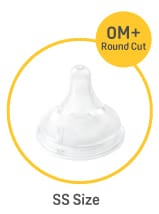
The slowest flow in the SofTouch range, designed for colostrum and the first transitional milk. Newborns have small stomachs (about 5 ml at day one, 30 ml at week one) and weak suck strength. A faster teat would overwhelm them. SS is round, with a small pinhole. Most babies use SS for 3 to 6 weeks before moving on. Some preterm or small-for-age babies stay longer.
S: 1 to 3 months
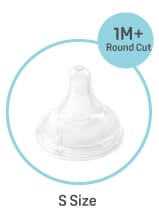
The first upgrade for most babies. Stronger suck, bigger stomach (about 90 to 150 ml per feed), but still benefits from a controlled round-hole flow. You will notice baby drinking more confidently, less coughing, and shorter feeds than on SS. Many Singapore babies sit on S through the first growth spurt at 6 weeks, then step up around 10 to 12 weeks.
M: 3 to 6 months
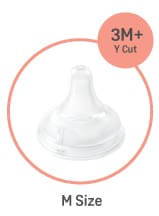
Medium flow for a baby whose suck has strengthened and whose appetite is now substantial. Often around 120 to 180 ml per feed. This is the size most parents find themselves on for the longest stretch. The Pigeon SofTouch Teat Size M (2-pack) is one of our most common replacements in the range.
L: 6 to 9 months
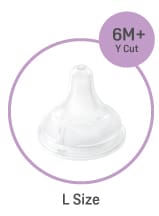
Y-cut variable flow. The shape of the hole changes from a simple round pinhole to a Y-shaped slit, which means the teat delivers a faster flow when baby sucks hard and less when they suck lightly. This matches how babies drink at this age, where they want to drink quickly and then rest. Solids usually start around this time, so milk feeds are fewer but bigger.
LL: 9+ months
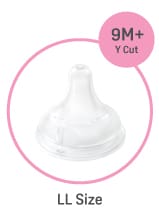
Y-cut with the largest variable flow. Suitable for thicker milk and for toddlers. Some babies skip this size if they are mostly on solids by 9 months. Others use it through 18 months alongside cup drinking.
SofTouch vs SofTouch Wide Neck vs Peristaltic Plus: Which Teat for Your Bottle?
A wide-neck bottle needs a wide-neck teat. A standard-neck bottle needs a standard-neck teat. Mixing them causes leaks and poor latching.
| Teat line | Fits bottle | Best for |
|---|---|---|
| SofTouch Peristaltic Plus | Standard-neck SofTouch bottles | Exclusive or primary bottle-feeding, breast-to-bottle transition |
| SofTouch Wide Neck | Wide-neck SofTouch bottles | Thicker liquids, easier filling and cleaning |
| Mix & Match nipples | Non-Pigeon standard bottles | Parents who have bottles from other brands |
Not sure which bottle you have? The collar diameter is the quickest tell. Wide-neck bottles have an opening of roughly 5 cm across. Standard-neck is about 3.5 cm. If you are looking for a Pigeon wide neck teat, the Wide Neck range covers all sizes from SS through LL. If you are on a non-Pigeon bottle, the Pigeon Mix & Match nipples fit a range of standard-neck bottles from other brands.
When to Replace Your Pigeon Teat (Not Just Size Up)
Size change is about baby's growth. Replacement is about the teat wearing out. Replace a teat when any of the following is true:
- Two months of regular use have passed, regardless of how it looks
- There is any visible damage: tears, tooth marks, cracks, or cloudiness
- The flow has changed, slower or faster, without a change in size
- The teat will not return to its original shape after sterilising
- The teat feels sticky or tacky to touch
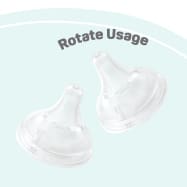
Keeping two teats in rotation per bottle extends usable life. Each teat spends less time under heat, each gets a rest between feeds, and the pair together tends to outlast one teat in constant use.
When Baby Fights the Bottle (Not Always a Size Issue)
If your baby is squirming, crying, or pulling away at the bottle, a size change is one of several possibilities. Other causes include flow mismatch, air gulping, temperature mismatch, or nipple confusion in combo-fed babies. Paced bottle feeding is often the single biggest fix for fussy feeders, and our companion guide on why babies fight the bottle and paced feeding technique covers it in detail.
If baby's nipple is collapsing during feeds specifically, check Pigeon's official FAQ on teat collapsing. Most of the time the fix is loosening the collar a quarter turn to restore air flow.
Singapore-Specific: Buying, Retailers, and Return to Work
Pigeon teats and bottles are stocked widely across Singapore at FairPrice, Watsons, Guardian, Mothercare, and Kiddy Palace. Most retailers carry the standard SS, S, M, L sizes. For LL, Wide Neck variants, or Mix & Match, the Pigeon Singapore online store usually has the widest selection.
If you are preparing to return to work and bottle-feed for the first time, many Singapore parents find it useful to get an IBCLC (International Board Certified Lactation Consultant) visit before the handover, so baby, caregiver, and bottle are all introduced while breastfeeding support is still available. KK Women's and Children's Hospital runs a lactation clinic that covers bottle transition too.
Frequently Asked Questions
When should I change my baby's bottle nipple size?
Size up when feeds are taking longer than 20 minutes, baby is fussing or pulling off, or you see fast sucking with little swallowing. Size down if milk leaks from the corner of the mouth or baby is gulping and coughing. Use the drip test as a quick check. One drop per second is the target for most ages.
What flow rate does each Pigeon teat size deliver?
SS and S are round-hole with progressively larger pinholes, producing a slow steady drip. M is a medium round hole. L and LL use Y-cut slits that deliver variable flow based on how hard baby sucks. The exact flow rates vary because Pigeon's peristaltic design responds to baby's suck strength rather than delivering a fixed rate.
How long should a bottle feed take at 3 months?
For a typical 3-month-old on an M teat, 10 to 15 minutes per feed is normal. If it is consistently shorter, the flow may be too fast. If consistently longer, the teat may need stepping up to the next size.
What size teat does a newborn need?
SS, the slowest flow. Newborns have tiny stomachs and weak suck strength in the first weeks. SS matches that. Most babies move to S between 3 and 6 weeks.
How do I know if the nipple flow is too fast?
Milk leaks from the corner of the mouth, baby gulps or coughs, feeds finish in under 5 minutes when they used to take longer, or baby seems overwhelmed and turns away. The drip test confirms: if milk streams out rather than drips, it is too fast.
Can I skip a teat size?
Usually not a good idea. Each size is designed to match suck strength at that stage. Skipping a size (say, going from S straight to L) often causes fast-flow overwhelm. If your current size is too slow, step to the next size, not two.
SofTouch vs SofTouch Wide Neck: which fits my bottle?
Standard-neck SofTouch teats fit only standard-neck SofTouch bottles. Wide-neck SofTouch teats fit only wide-neck bottles. They are not interchangeable. Check your bottle's opening diameter (3.5 cm for standard, 5 cm for wide-neck).
Why is my baby's nipple collapsing during feeds?
The most common cause is over-tightening the bottle collar, which blocks the air vent and creates a vacuum. Loosen the collar a quarter turn and the teat should return to shape. If it keeps happening, the teat may need replacing.
How long do Pigeon bottle teats last?
About 2 months under regular use, or sooner if you see tears, stickiness, cloudiness, or shape changes after sterilising. Keeping two teats in rotation per bottle roughly doubles the usable life of each.
Does bottle nipple size really matter?
Yes. Flow rate affects how much air baby swallows, how fast they feed, and whether feeds feel calm or frantic. A teat that is too fast causes gulping, gas, and often fussy behaviour. A teat that is too slow causes baby to give up before finishing. Matching size to age is one of the most consistent fixes for feeding problems.
Can a fast-flow nipple make baby reflux worse?
Yes. Fast flow causes gulping and air swallowing, both of which increase reflux symptoms. If baby has reflux, sizing down and pacing the feed (paced bottle feeding) both reduce the pressure and the air intake.
Why do I need to sterilise baby bottles and teats?
Babies under 12 months have developing immune systems and are more vulnerable to bacteria. Sterilising after each day's use (or more often in the first 6 weeks) reduces infection risk. Steam sterilisers like Pigeon's POCHItto are gentler on teat silicone than stovetop boiling.
Find the Right Size Teat for Your Baby
When you are ready to size up or replace, the Pigeon SofTouch range covers every size from SS through LL. If you have a wide-neck bottle, the Wide Neck teat collection is the match. For non-Pigeon bottles, Mix & Match nipples fit a range of standard-neck alternatives.
Every baby is different, and the signs above matter more than the calendar. If you are working through this and still unsure, our Singapore support team is here, and so are the lactation clinics at KK Hospital. We have been part of Singapore feeding journeys since the 1970s, and we are here for yours.
JSON-LD schema for this page
For dev / SEO reviewBlogPosting + FAQPage + BreadcrumbList. Entities (about + mentions) sourced from TextRazor + manually mapped Pigeon-specific entities to Wikidata/Wikipedia.
{
  "@context": "https://schema.org",
  "@graph": [
    {
      "@type": "BreadcrumbList",
      "@id": "https://pigeon.com.sg/blogs_articles/how-to-choose-the-right-bottle-nipple-by-age-when-to-switch-nipple-sizes/#breadcrumb",
      "itemListElement": [
        {
          "@type": "ListItem",
          "position": 1,
          "name": "Home",
          "item": "https://pigeon.com.sg/"
        },
        {
          "@type": "ListItem",
          "position": 2,
          "name": "Blogs & Articles",
          "item": "https://pigeon.com.sg/blogs_articles/"
        },
        {
          "@type": "ListItem",
          "position": 3,
          "name": "Baby Bottle Nipple Sizes by Age: Pigeon Teat Guide (2026)"
        }
      ]
    },
    {
      "@type": "BlogPosting",
      "@id": "https://pigeon.com.sg/blogs_articles/how-to-choose-the-right-bottle-nipple-by-age-when-to-switch-nipple-sizes/#blogposting",
      "headline": "Baby Bottle Nipple Sizes by Age: Pigeon Teat Guide (2026)",
      "description": "Pigeon teat size by age (SS/S/M/L/LL): when to change bottle nipple size, drip test, flow rate troubleshooting. Singapore parent guide updated 2026.",
      "datePublished": "2024-11-15",
      "dateModified": "2026-04-21",
      "author": {
        "@id": "https://pigeon.com.sg/#organization"
      },
      "publisher": {
        "@id": "https://pigeon.com.sg/#organization"
      },
      "mainEntityOfPage": "https://pigeon.com.sg/blogs_articles/how-to-choose-the-right-bottle-nipple-by-age-when-to-switch-nipple-sizes/",
      "image": "https://b2907581.smushcdn.com/2907581/wp-content/uploads/2024/11/Nipple-Guide-rotate.jpg",
      "inLanguage": "en-SG",
      "about": [
        {
          "@type": "Thing",
          "name": "Pigeon Singapore",
          "@id": "https://pigeon.com.sg/#organization"
        },
        {
          "@type": "Thing",
          "name": "Pigeon Corporation",
          "sameAs": [
            "https://www.wikidata.org/wiki/Q11331467",
            "https://en.wikipedia.org/wiki/Pigeon_Corporation"
          ]
        },
        {
          "@type": "Thing",
          "name": "Pigeon SofTouch",
          "sameAs": "https://shop.pigeon.com.sg/collections/softouch"
        },
        {
          "@type": "Thing",
          "name": "Baby bottle",
          "sameAs": [
            "https://www.wikidata.org/wiki/Q797906",
            "https://en.wikipedia.org/wiki/Baby_bottle"
          ]
        },
        {
          "@type": "Thing",
          "name": "Breastfeeding",
          "sameAs": [
            "https://www.wikidata.org/wiki/Q174876",
            "https://en.wikipedia.org/wiki/Breastfeeding"
          ]
        }
      ],
      "mentions": [
        {
          "@type": "Thing",
          "name": "Infant",
          "sameAs": [
            "https://www.wikidata.org/wiki/Q998",
            "https://en.wikipedia.org/wiki/Infant"
          ]
        },
        {
          "@type": "Thing",
          "name": "Lactation consultant",
          "sameAs": [
            "https://www.wikidata.org/wiki/Q6048774",
            "https://en.wikipedia.org/wiki/Lactation_consultant"
          ]
        },
        {
          "@type": "Thing",
          "name": "Nipple confusion",
          "sameAs": [
            "https://www.wikidata.org/wiki/Q2227415",
            "https://en.wikipedia.org/wiki/Nipple_confusion"
          ]
        },
        {
          "@type": "Thing",
          "name": "Gastroesophageal reflux disease",
          "sameAs": [
            "https://www.wikidata.org/wiki/Q223591",
            "https://en.wikipedia.org/wiki/Gastroesophageal_reflux_disease"
          ]
        },
        {
          "@type": "Thing",
          "name": "Milk",
          "sameAs": [
            "https://www.wikidata.org/wiki/Q8495",
            "https://en.wikipedia.org/wiki/Milk"
          ]
        },
        {
          "@type": "Thing",
          "name": "Lactation",
          "sameAs": [
            "https://www.wikidata.org/wiki/Q719426",
            "https://en.wikipedia.org/wiki/Lactation"
          ]
        },
        {
          "@type": "Thing",
          "name": "Preterm birth",
          "sameAs": [
            "https://www.wikidata.org/wiki/Q625506",
            "https://en.wikipedia.org/wiki/Preterm_birth"
          ]
        }
      ]
    },
    {
      "@type": "FAQPage",
      "@id": "https://pigeon.com.sg/blogs_articles/how-to-choose-the-right-bottle-nipple-by-age-when-to-switch-nipple-sizes/#faq",
      "mainEntity": [
        {
          "@type": "Question",
          "name": "When should I change my baby's bottle nipple size?",
          "acceptedAnswer": {
            "@type": "Answer",
            "text": "Size up when feeds are taking longer than 20 minutes, baby is fussing or pulling off, or you see fast sucking with little swallowing. Size down if milk leaks from the corner of the mouth or baby is gulping and coughing. Use the drip test as a quick check. One drop per second is the target for most ages."
          }
        },
        {
          "@type": "Question",
          "name": "What flow rate does each Pigeon teat size deliver?",
          "acceptedAnswer": {
            "@type": "Answer",
            "text": "SS and S are round-hole with progressively larger pinholes, producing a slow steady drip. M is a medium round hole. L and LL use Y-cut slits that deliver variable flow based on how hard baby sucks. The exact flow rates vary because Pigeon's peristaltic design responds to baby's suck strength rather than delivering a fixed rate."
          }
        },
        {
          "@type": "Question",
          "name": "How long should a bottle feed take at 3 months?",
          "acceptedAnswer": {
            "@type": "Answer",
            "text": "For a typical 3-month-old on an M teat, 10 to 15 minutes per feed is normal. If it is consistently shorter, the flow may be too fast. If consistently longer, the teat may need stepping up to the next size."
          }
        },
        {
          "@type": "Question",
          "name": "What size teat does a newborn need?",
          "acceptedAnswer": {
            "@type": "Answer",
            "text": "SS, the slowest flow. Newborns have tiny stomachs and weak suck strength in the first weeks. SS matches that. Most babies move to S between 3 and 6 weeks."
          }
        },
        {
          "@type": "Question",
          "name": "How do I know if the nipple flow is too fast?",
          "acceptedAnswer": {
            "@type": "Answer",
            "text": "Milk leaks from the corner of the mouth, baby gulps or coughs, feeds finish in under 5 minutes when they used to take longer, or baby seems overwhelmed and turns away. The drip test confirms: if milk streams out rather than drips, it is too fast."
          }
        },
        {
          "@type": "Question",
          "name": "Can I skip a teat size?",
          "acceptedAnswer": {
            "@type": "Answer",
            "text": "Usually not a good idea. Each size is designed to match suck strength at that stage. Skipping a size (say, going from S straight to L) often causes fast-flow overwhelm. If your current size is too slow, step to the next size, not two."
          }
        },
        {
          "@type": "Question",
          "name": "SofTouch vs SofTouch Wide Neck: which fits my bottle?",
          "acceptedAnswer": {
            "@type": "Answer",
            "text": "Standard-neck SofTouch teats fit only standard-neck SofTouch bottles. Wide-neck SofTouch teats fit only wide-neck bottles. They are not interchangeable. Check your bottle's opening diameter (3.5 cm for standard, 5 cm for wide-neck)."
          }
        },
        {
          "@type": "Question",
          "name": "Why is my baby's nipple collapsing during feeds?",
          "acceptedAnswer": {
            "@type": "Answer",
            "text": "The most common cause is over-tightening the bottle collar, which blocks the air vent and creates a vacuum. Loosen the collar a quarter turn and the teat should return to shape. If it keeps happening, the teat may need replacing."
          }
        },
        {
          "@type": "Question",
          "name": "How long do Pigeon bottle teats last?",
          "acceptedAnswer": {
            "@type": "Answer",
            "text": "About 2 months under regular use, or sooner if you see tears, stickiness, cloudiness, or shape changes after sterilising. Keeping two teats in rotation per bottle roughly doubles the usable life of each."
          }
        },
        {
          "@type": "Question",
          "name": "Does bottle nipple size really matter?",
          "acceptedAnswer": {
            "@type": "Answer",
            "text": "Yes. Flow rate affects how much air baby swallows, how fast they feed, and whether feeds feel calm or frantic. A teat that is too fast causes gulping, gas, and often fussy behaviour. A teat that is too slow causes baby to give up before finishing. Matching size to age is one of the most consistent fixes for feeding problems."
          }
        },
        {
          "@type": "Question",
          "name": "Can a fast-flow nipple make baby reflux worse?",
          "acceptedAnswer": {
            "@type": "Answer",
            "text": "Yes. Fast flow causes gulping and air swallowing, both of which increase reflux symptoms. If baby has reflux, sizing down and pacing the feed (paced bottle feeding) both reduce the pressure and the air intake."
          }
        },
        {
          "@type": "Question",
          "name": "Why do I need to sterilise baby bottles and teats?",
          "acceptedAnswer": {
            "@type": "Answer",
            "text": "Babies under 12 months have developing immune systems and are more vulnerable to bacteria. Sterilising after each day's use (or more often in the first 6 weeks) reduces infection risk. Steam sterilisers like Pigeon's POCHItto are gentler on teat silicone than stovetop boiling."
          }
        }
      ]
    }
  ]
}
JSON-LD schema for this page
For dev / SEO reviewBlogPosting + FAQPage + BreadcrumbList. Entities (about + mentions) sourced from TextRazor + manually mapped Pigeon-specific entities to Wikidata/Wikipedia.
{
  "@context": "https://schema.org",
  "@graph": [
    {
      "@type": "BreadcrumbList",
      "@id": "https://pigeon.com.sg/blogs_articles/how-to-choose-the-right-bottle-nipple-by-age-when-to-switch-nipple-sizes/#breadcrumb",
      "itemListElement": [
        {
          "@type": "ListItem",
          "position": 1,
          "name": "Home",
          "item": "https://pigeon.com.sg/"
        },
        {
          "@type": "ListItem",
          "position": 2,
          "name": "Blogs & Articles",
          "item": "https://pigeon.com.sg/blogs_articles/"
        },
        {
          "@type": "ListItem",
          "position": 3,
          "name": "Baby Bottle Nipple Sizes by Age: Pigeon Teat Guide (2026)"
        }
      ]
    },
    {
      "@type": "BlogPosting",
      "@id": "https://pigeon.com.sg/blogs_articles/how-to-choose-the-right-bottle-nipple-by-age-when-to-switch-nipple-sizes/#blogposting",
      "headline": "Baby Bottle Nipple Sizes by Age: Pigeon Teat Guide (2026)",
      "description": "Pigeon teat size by age (SS/S/M/L/LL): when to change bottle nipple size, drip test, flow rate troubleshooting. Singapore parent guide updated 2026.",
      "datePublished": "2024-11-15",
      "dateModified": "2026-04-21",
      "author": {
        "@id": "https://pigeon.com.sg/#organization"
      },
      "publisher": {
        "@id": "https://pigeon.com.sg/#organization"
      },
      "mainEntityOfPage": "https://pigeon.com.sg/blogs_articles/how-to-choose-the-right-bottle-nipple-by-age-when-to-switch-nipple-sizes/",
      "image": "https://b2907581.smushcdn.com/2907581/wp-content/uploads/2024/11/Nipple-Guide-rotate.jpg",
      "inLanguage": "en-SG",
      "about": [
        {
          "@type": "Thing",
          "name": "Pigeon Singapore",
          "@id": "https://pigeon.com.sg/#organization"
        },
        {
          "@type": "Thing",
          "name": "Pigeon Corporation",
          "sameAs": [
            "https://www.wikidata.org/wiki/Q11331467",
            "https://en.wikipedia.org/wiki/Pigeon_Corporation"
          ]
        },
        {
          "@type": "Thing",
          "name": "Pigeon SofTouch",
          "sameAs": "https://shop.pigeon.com.sg/collections/softouch"
        },
        {
          "@type": "Thing",
          "name": "Baby bottle",
          "sameAs": [
            "https://www.wikidata.org/wiki/Q797906",
            "https://en.wikipedia.org/wiki/Baby_bottle"
          ]
        },
        {
          "@type": "Thing",
          "name": "Breastfeeding",
          "sameAs": [
            "https://www.wikidata.org/wiki/Q174876",
            "https://en.wikipedia.org/wiki/Breastfeeding"
          ]
        }
      ],
      "mentions": [
        {
          "@type": "Thing",
          "name": "Nipple confusion",
          "sameAs": [
            "https://www.wikidata.org/wiki/Q2227415",
            "https://en.wikipedia.org/wiki/Nipple_confusion"
          ]
        },
        {
          "@type": "Thing",
          "name": "Infant",
          "sameAs": [
            "https://www.wikidata.org/wiki/Q998",
            "https://en.wikipedia.org/wiki/Infant"
          ]
        },
        {
          "@type": "Thing",
          "name": "Lactation consultant",
          "sameAs": [
            "https://www.wikidata.org/wiki/Q6048774",
            "https://en.wikipedia.org/wiki/Lactation_consultant"
          ]
        },
        {
          "@type": "Thing",
          "name": "Milk",
          "sameAs": [
            "https://www.wikidata.org/wiki/Q8495",
            "https://en.wikipedia.org/wiki/Milk"
          ]
        },
        {
          "@type": "Thing",
          "name": "Gastroesophageal reflux disease",
          "sameAs": [
            "https://www.wikidata.org/wiki/Q223591",
            "https://en.wikipedia.org/wiki/Gastroesophageal_reflux_disease"
          ]
        },
        {
          "@type": "Thing",
          "name": "Wikidata",
          "sameAs": [
            "https://www.wikidata.org/wiki/Q2013",
            "https://en.wikipedia.org/wiki/Wikidata"
          ]
        },
        {
          "@type": "Thing",
          "name": "Lactation",
          "sameAs": [
            "https://www.wikidata.org/wiki/Q719426",
            "https://en.wikipedia.org/wiki/Lactation"
          ]
        }
      ]
    },
    {
      "@type": "FAQPage",
      "@id": "https://pigeon.com.sg/blogs_articles/how-to-choose-the-right-bottle-nipple-by-age-when-to-switch-nipple-sizes/#faq",
      "mainEntity": [
        {
          "@type": "Question",
          "name": "When should I change my baby's bottle nipple size?",
          "acceptedAnswer": {
            "@type": "Answer",
            "text": "Size up when feeds are taking longer than 20 minutes, baby is fussing or pulling off, or you see fast sucking with little swallowing. Size down if milk leaks from the corner of the mouth or baby is gulping and coughing. Use the drip test as a quick check. One drop per second is the target for most ages."
          }
        },
        {
          "@type": "Question",
          "name": "What flow rate does each Pigeon teat size deliver?",
          "acceptedAnswer": {
            "@type": "Answer",
            "text": "SS and S are round-hole with progressively larger pinholes, producing a slow steady drip. M is a medium round hole. L and LL use Y-cut slits that deliver variable flow based on how hard baby sucks. The exact flow rates vary because Pigeon's peristaltic design responds to baby's suck strength rather than delivering a fixed rate."
          }
        },
        {
          "@type": "Question",
          "name": "How long should a bottle feed take at 3 months?",
          "acceptedAnswer": {
            "@type": "Answer",
            "text": "For a typical 3-month-old on an M teat, 10 to 15 minutes per feed is normal. If it is consistently shorter, the flow may be too fast. If consistently longer, the teat may need stepping up to the next size."
          }
        },
        {
          "@type": "Question",
          "name": "What size teat does a newborn need?",
          "acceptedAnswer": {
            "@type": "Answer",
            "text": "SS, the slowest flow. Newborns have tiny stomachs and weak suck strength in the first weeks. SS matches that. Most babies move to S between 3 and 6 weeks."
          }
        },
        {
          "@type": "Question",
          "name": "How do I know if the nipple flow is too fast?",
          "acceptedAnswer": {
            "@type": "Answer",
            "text": "Milk leaks from the corner of the mouth, baby gulps or coughs, feeds finish in under 5 minutes when they used to take longer, or baby seems overwhelmed and turns away. The drip test confirms: if milk streams out rather than drips, it is too fast."
          }
        },
        {
          "@type": "Question",
          "name": "Can I skip a teat size?",
          "acceptedAnswer": {
            "@type": "Answer",
            "text": "Usually not a good idea. Each size is designed to match suck strength at that stage. Skipping a size (say, going from S straight to L) often causes fast-flow overwhelm. If your current size is too slow, step to the next size, not two."
          }
        },
        {
          "@type": "Question",
          "name": "SofTouch vs SofTouch Wide Neck: which fits my bottle?",
          "acceptedAnswer": {
            "@type": "Answer",
            "text": "Standard-neck SofTouch teats fit only standard-neck SofTouch bottles. Wide-neck SofTouch teats fit only wide-neck bottles. They are not interchangeable. Check your bottle's opening diameter (3.5 cm for standard, 5 cm for wide-neck)."
          }
        },
        {
          "@type": "Question",
          "name": "Why is my baby's nipple collapsing during feeds?",
          "acceptedAnswer": {
            "@type": "Answer",
            "text": "The most common cause is over-tightening the bottle collar, which blocks the air vent and creates a vacuum. Loosen the collar a quarter turn and the teat should return to shape. If it keeps happening, the teat may need replacing."
          }
        },
        {
          "@type": "Question",
          "name": "How long do Pigeon bottle teats last?",
          "acceptedAnswer": {
            "@type": "Answer",
            "text": "About 2 months under regular use, or sooner if you see tears, stickiness, cloudiness, or shape changes after sterilising. Keeping two teats in rotation per bottle roughly doubles the usable life of each."
          }
        },
        {
          "@type": "Question",
          "name": "Does bottle nipple size really matter?",
          "acceptedAnswer": {
            "@type": "Answer",
            "text": "Yes. Flow rate affects how much air baby swallows, how fast they feed, and whether feeds feel calm or frantic. A teat that is too fast causes gulping, gas, and often fussy behaviour. A teat that is too slow causes baby to give up before finishing. Matching size to age is one of the most consistent fixes for feeding problems."
          }
        },
        {
          "@type": "Question",
          "name": "Can a fast-flow nipple make baby reflux worse?",
          "acceptedAnswer": {
            "@type": "Answer",
            "text": "Yes. Fast flow causes gulping and air swallowing, both of which increase reflux symptoms. If baby has reflux, sizing down and pacing the feed (paced bottle feeding) both reduce the pressure and the air intake."
          }
        },
        {
          "@type": "Question",
          "name": "Why do I need to sterilise baby bottles and teats?",
          "acceptedAnswer": {
            "@type": "Answer",
            "text": "Babies under 12 months have developing immune systems and are more vulnerable to bacteria. Sterilising after each day's use (or more often in the first 6 weeks) reduces infection risk. Steam sterilisers like Pigeon's POCHItto are gentler on teat silicone than stovetop boiling."
          }
        }
      ]
    }
  ]
}